Don’t Worship the “Single Model” in AI Delivery: Why “Model Routing” Is the Cost-Effective Choice for Engineering
In the actual delivery process within AI Labs, many teams fall into a common trap: trying to find a single “all-powerful” model to solve every problem.
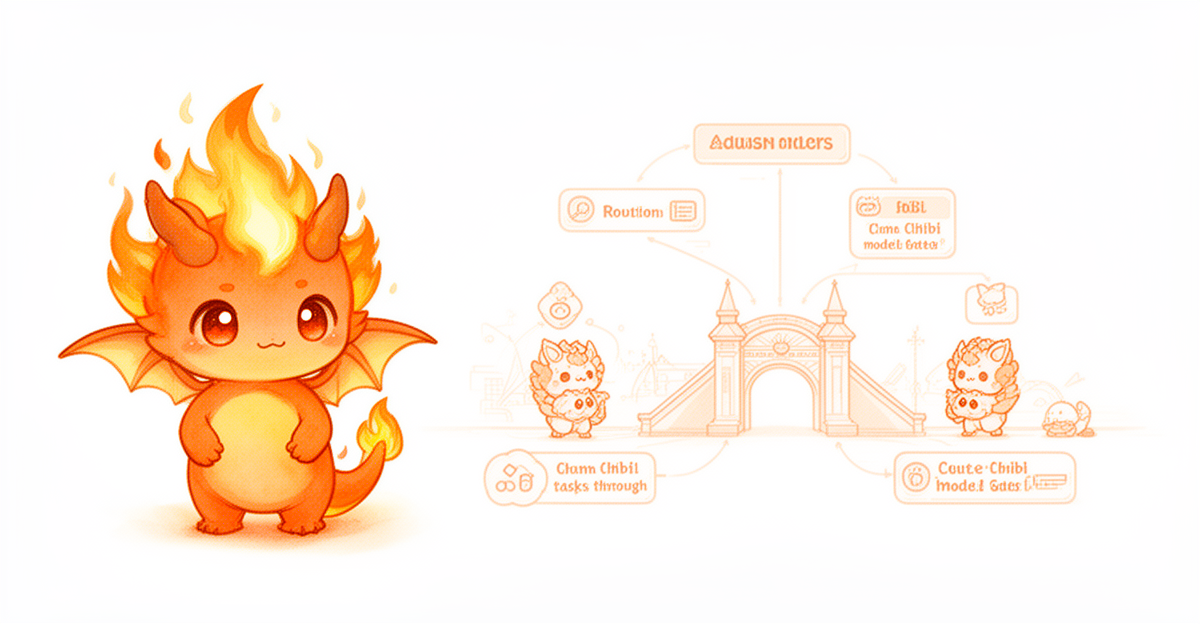
Don’t Worship the “Single Model” in AI Delivery: Why “Model Routing” Is the Cost-Effective Choice for Engineering
In the actual delivery process within AI Labs, many teams fall into a common trap: trying to find a single “all-powerful” model to solve every problem.
Whether chasing the ultimate performance of GPT-4o or experimenting with the latest Claude 3.5, teams often pour all their energy into using one super model to cover every scenario, from simple formatting tasks to complex logical reasoning. The result? Exploding costs, uncontrollable latency, and ironically, the super model’s response speed becomes a bottleneck for delivery when handling simple tasks.
True AI engineering operations should focus on “precisely matching capabilities with costs,” and the core technical path to achieve this is Model Routing.
What Is Model Routing in an Engineering Context?
Model routing is not just simple if-else logic; it is a dynamic distribution mechanism based on task complexity, real-time requirements, and cost budgets.
In our delivery pipeline, we categorize tasks into three levels:
- L1: Deterministic/Formatting Tasks (e.g., JSON extraction, simple translation, text cleaning). These tasks do not require deep reasoning and can be handled by lightweight models (such as GPT-4o-mini or Llama-3-8B), offering fast speeds and extremely low costs.
- L2: Structured Reasoning/Content Generation Tasks (e.g., draft writing, code snippet generation). These require a certain level of context understanding and linguistic flair, making them suitable for mid-tier models.
- L3: Complex Logic/Architecture Design/Deep Audit Tasks (e.g., system architecture review, complex bug localization). The most powerful models must be invoked here to ensure accuracy.
Three Core Benefits of Model Routing
1. Drastically Reduce End-to-End Latency
If a simple JSON extraction task is sent to the most powerful model, you might wait 3–5 seconds; however, routing it to a lightweight model can compress the response time to under 500ms. For interactive products where user perception is critical, this magnitude of improvement directly determines the product’s “smoothness.”
2. Achieve Exponential Cost Reduction
When processing massive amounts of data, the token costs of using top-tier models exclusively are staggering. By using a routing mechanism to divert 80% of simple tasks to L1 models, overall API expenses can be reduced by 70%–90%, with almost no loss in final delivery quality.
3. Improve System Robustness
Relying on a single model carries the risk of a “single point of failure” (for example, a version update causing performance degradation on specific tasks). The routing layer allows us to quickly switch to fallback models. If the primary routed model encounters anomalies or times out, the system automatically switches to another provider’s model at the same level, ensuring the delivery pipeline remains uninterrupted.
How to Implement a Simple Routing Strategy?
For most AI Lab teams, there is no need to build complex machine learning classifiers for routing. Instead, we recommend the following three-step strategy:
Step 1: Define Task Tags
Clarify the nature of the request at the prompt level. For instance, mark requests with predefined tags such as [FORMATTING] or [REASONING] using templates.
Step 2: Establish Capability Baselines
For each category of tagged tasks, run a small-scale test set (Golden Set) to verify whether the L1 model can achieve over 95% of the accuracy of the L3 model. If it can, permanently downgrade those tasks to L1.
Step 3: Implement Dynamic Fallback
Set timeout thresholds (e.g., if the L1 model does not respond within 2 seconds), and automatically upgrade the request to L2 or L3 models for retry.
Final Thoughts
The essence of AI engineering is not pursuing the “strongest,” but rather the “most suitable.”
A routing system capable of flexibly scheduling models of different scales is far more powerful than a system relying on a single super model. It transforms AI from an expensive “lab toy” into an predictable, scalable, and commercially viable engineering product. Stop worshipping all-powerful models; instead, focus your energy on building that “traffic control system” capable of precise distribution.
Comments
Share your thoughts!
Loading comments…