
Stop Saying 'AI Will Replace Programmers' — What's Actually Happening Is Way More Complicated
Stop Saying "AI Will Replace Programmers" — What's Actually Happening Is Way More Complicated Every few months, there's a fresh wave of "AI is going to repla…
Stop Saying "AI Will Replace Programmers" — What's Actually Happening Is Way More Complicated
Every few months, there's a fresh wave of "AI is going to replace programmers" panic. The latest round was triggered by Claude and Cursor getting scary good at writing code, followed by a flood of clickbait headlines: "Programmers are about to be unemployed!"
As a team that uses AI to write code every single day, I have to say: these people probably haven't actually used AI to write production code.
AI Is Great at Writing Code, but "Writing" Isn't All of Software Development
Let's acknowledge the obvious: AI has gotten really good at writing code. Claude can crank out a complete Vue component in one go, Cursor can auto-complete complex logic based on context, and GitHub Copilot's suggestions keep getting more accurate.
But how much of software development is actually "writing code"? Maybe 30%.
What's the other 70%?
- Understanding requirements — A client says "I want a simple page," but what they're actually picturing is a full application with payments, user accounts, and an admin dashboard. Understanding what "simple" really means? AI can't do that yet.
- Architecture decisions — Microservices or monolith? PostgreSQL or MongoDB? Redis or Memcached? These decisions require understanding the business context, team size, and ops capabilities — not something you solve with "write me some code."
- Debugging — Code's written but won't run, the error message is just "Segfault," and you spend three hours tracking down which pointer went haywire. AI can help look up errors, but that gut-level debugging instinct — "this bug smells like a race condition" — that's still a uniquely human skill.
- Communication and coordination — Arguing with the product manager about priority, aligning UI details with designers, discussing deployment strategy with ops. Software development is fundamentally a social activity, not just a technical one.
What's Really Happening: Programmers Are Becoming "AI Managers"
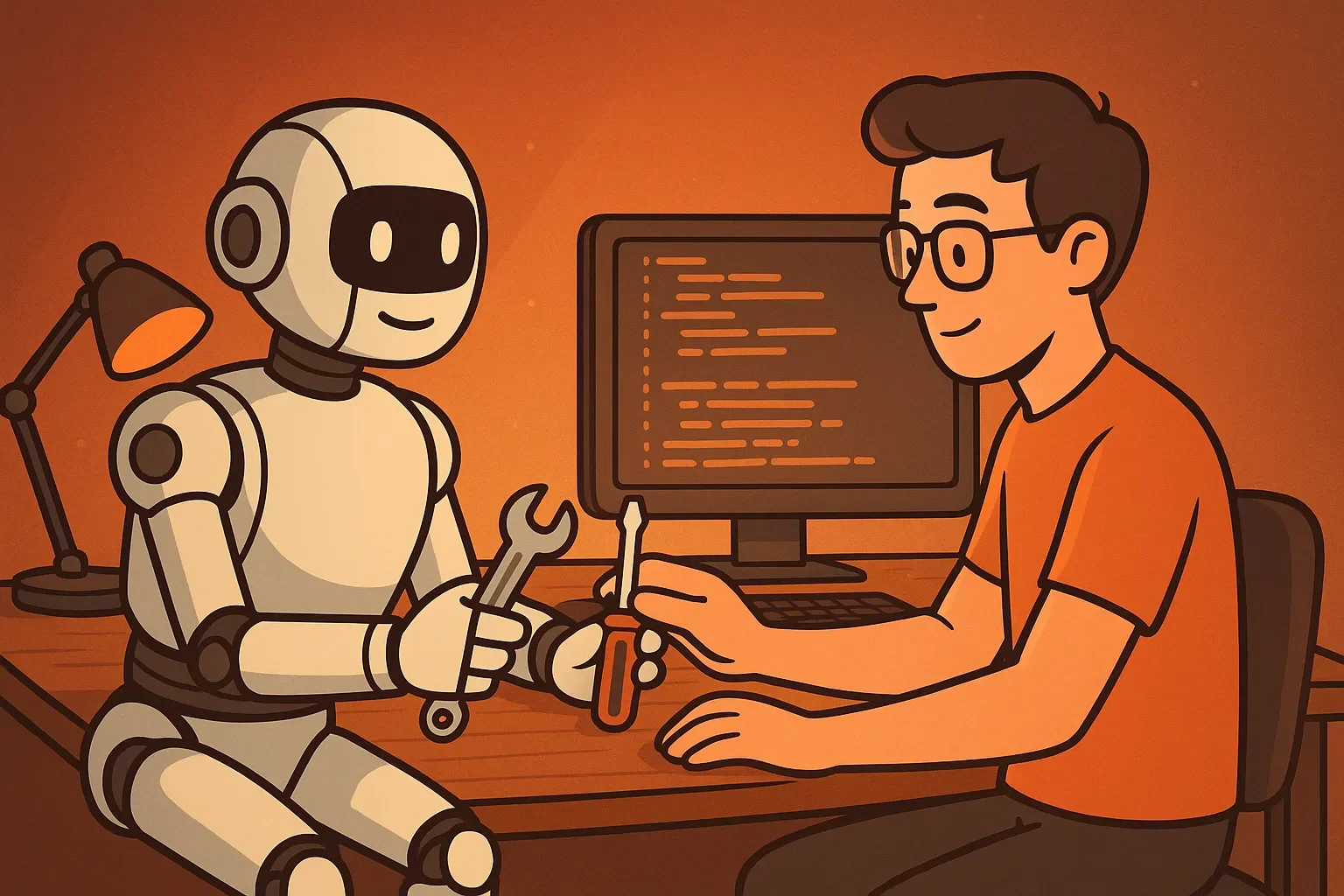
The trend I'm seeing isn't AI replacing programmers — it's the way programmers work that's changing.
Programmers used to be the kind of people who "wrote everything from scratch." Now they're increasingly becoming "editors of AI-generated code" — AI writes the first draft, humans review, fix bugs, make architecture calls, and handle edge cases.
Here's an analogy: programmers used to be the cook — washing, chopping, stir-frying, plating, all by themselves. Now they're becoming the head chef — you don't need to julienne every carrot yourself, but you need to know when to add salt, whether the heat is right, and whether the dish will satisfy the customer.
Is being head chef easier than being the cook? Not necessarily. But it requires different skills.
Which Programmers Will Actually Be Affected
Done with the good news, time for some real talk.
One type of work will definitely shrink: the kind where you "translate a spec document into code line by line." If your daily job is turning Figma mockups into HTML+CSS, or churning out repetitive CRUD endpoints, AI can indeed match that quality — and do it ten times faster.
But here's the thing: this type of work was already being eaten by low-code platforms before AI showed up. AI just accelerated the trend.
The truly competitive programmers were never the ones who "write more code" — they're the ones who "solve harder problems." AI has lowered the barrier to writing code, which means the value of simply "being able to write code" is declining, but the value of "judging code quality," "designing systems," and "defining problems" is going up.
Advice for Non-Technical Readers
If you're not a programmer but care about AI's impact on jobs, here's my take:
1. Don't buy into the fear-mongering. "AI replaces XXX" makes for great clickbait, but it's miles from reality. Every tech revolution has triggered similar panic, from the power loom to the ATM. Jobs don't disappear — they change.
2. Focus on what AI can't do well. Judgment, communication, making decisions in ambiguous situations, understanding what people actually need — AI isn't good at any of these in the short term.
3. Learn to work with AI. Whatever your profession, learning to use AI tools to boost productivity is a plus. You don't need to learn to code, but you do need to learn how to communicate your needs clearly to an AI.
SFD Editor's Note
Our lab is a living example. 13 AI Agents working together — sounds like sci-fi, but in practice, the most time-consuming part isn't getting AI to write code. It's coordination, review, error correction, and decision-making. After AI writes the code, there's still an Agent for security audits, an Agent for testing, an Agent for deployment, and an Agent for QA.
Put simply, AI made "writing" cheap, but made "managing" more important. Future software teams might only need three to five people, but each person could be managing a dozen or more AI Agents. People aren't being replaced — the way they work is changing.
So next time someone tells you "Learning to code is pointless now, AI can do it," you can fire back: "AI can cook too — are you planning to stop eating?"